Chapter 7 · Survival Matters More Than One Win: Exits, Events, and Position Size
Opening verseTo the Tune of Yu Mei Ren · Asking the Way
Who understands the depths of an unrealized loss,
while the lamp still burns at midnight?
Without noticing, frost gathers at the temples;
ten thousand questions disappear into the dark.
My dreams once held only seas of cloud;
I wake, and the position remains.
Do not speak of chasing tomorrow's trade.
Ask only whether today I kept my first resolve.
The preceding chapters focused on reading the market—GEX, VWAP, the three levels, and GVP.
But reading it correctly does not mean keeping the profit.
This chapter covers three more fundamental matters: exits, event days, and position size.
Correct direction is only the minimum requirement for entry. In 0DTE, the exit determines how much profit remains.
Being right is not the hard part. Keeping what the market offered is.
Correct Direction Does Not Guarantee Profit
Consider a day when price begins to rise and Gamma shifts from negative to positive.
Many traders identify the direction correctly. SPX is rising.
Yet most of the profit disappears, or the trade makes nothing.
Sometimes the market did not take them out. Stress forced an early exit, or they never knew where to leave.
Options are not stocks:
- A pullback in a stock may reduce profit by several points
- A pullback in an option can cut profit in half or turn a gain into a loss
Holding the right direction and retaining the profit are different skills.
Correct direction means only that your reading was not wrong. Until the money is realized, nothing is finished.
Profit Comes from a Gamma Burst, Not from Waiting
An option can double in minutes.
It can give the gain back just as quickly.
For an intraday 0DTE buyer, time is toxic. If the direction does not continue, another ten minutes can consume 20% of the gain through Theta.
Stock investors often wait for a trend or value to emerge. A long option earns its most violent profit from a burst: price moves in the favorable direction, Gamma increases Delta, and the option expands nonlinearly. That burst often arrives in the first tens of minutes after entry. Miss the window and it may not return.
I gave myself a deliberately simple rule:
Profit comes from the Gamma burst, not from waiting.
Take the burst and leave; do not demand the final stretch.
The Best Holding Window
How long is the window?
Many single-leg traders believe that if direction is right, they should continue holding. I did too. Reviewing more of my trades led me to a counterintuitive conclusion:
For a single-leg 0DTE option, the Gamma-burst window often lasts only 5–30 minutes after entry.
That is not a precise law. I grouped many trades roughly by minutes after entry and found that the richest segment of profit commonly fell in that range. The reason is straightforward: the first volatility expansion, accelerating Delta, and directional extension after a liquidity sweep are concentrated in those early minutes.
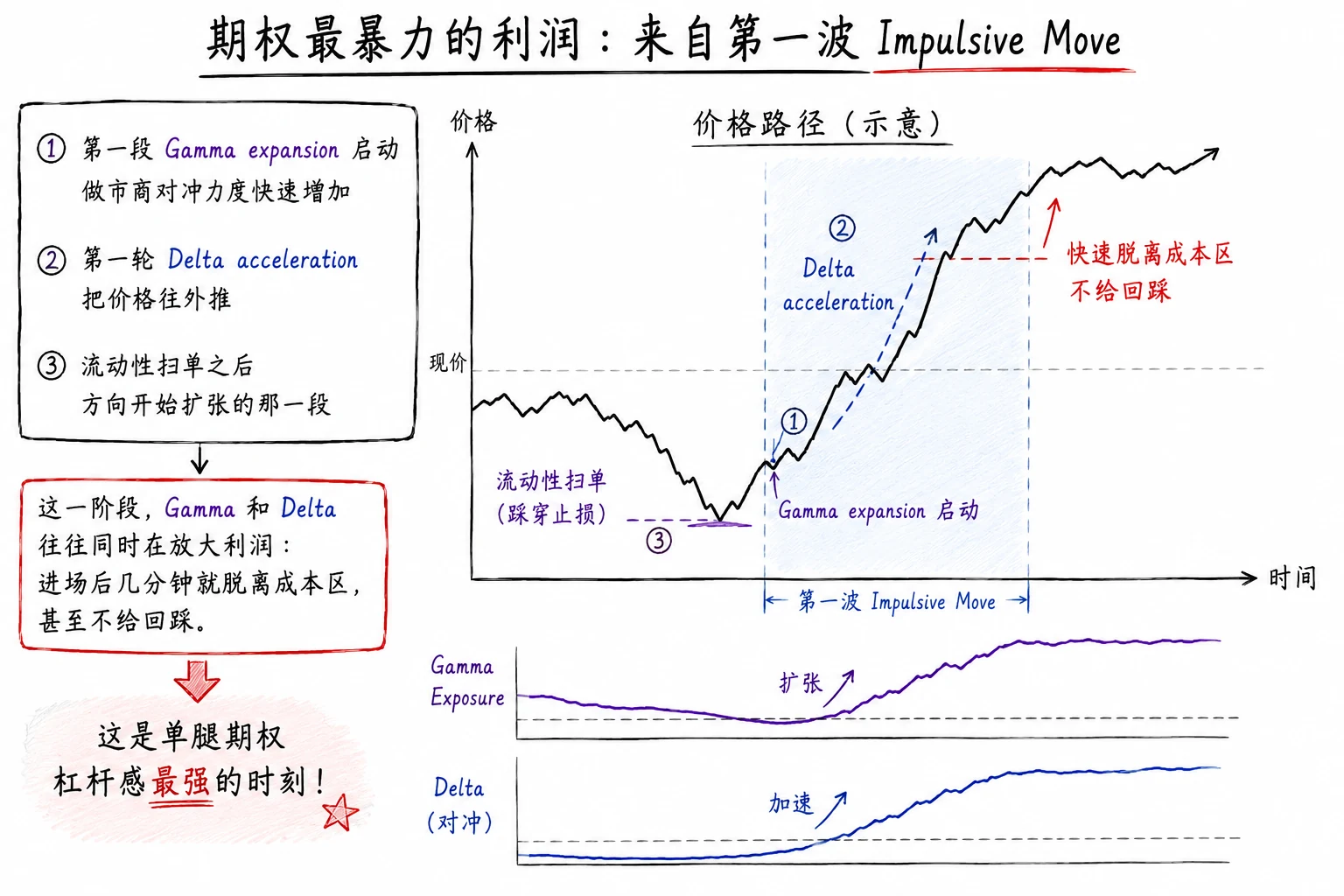
Gamma and Delta often amplify profit together during this stage. The trade leaves its cost area quickly and may not offer a retest.
Leverage feels strongest during this segment, yet the comfortable exit window is shortest. When the burst closes, the script often changes.
If you do not take the first wave, what comes later is often not a second wave but a drawdown.
Where is this especially common?
| Setting | Why the window is short |
|---|---|
| Single-leg SPX 0DTE | Theta counts by the minute |
| Opening-range breakout | The first expansion is often cleanest; later action can return to chop |
| Expansion after a VWAP reclaim | The first advance after cost-basis confirmation often has the most force |
| Negative-Gamma trend begins | Pro-cyclical market-maker hedging can push the position along |
Hedge adjustments are often most active during the first segment. If you miss it, the market may still move, but it is no longer offering the same kind of profit.
The 5–30 minute range changes with the market and volatility regime. It is a reminder not to hold long-premium 0DTE like stock, not an instruction to exit mechanically at minute 30. If structure remains strong and profit continues expanding, the trade can stay. Leave when the window closes and the force disappears.
What changes after the window?
After roughly 30–45 minutes, depending on the day, another script often begins:
- Price enters chop and advances more slowly
- Theta accelerates the loss of premium
- IV falls, shrinking premium even while direction remains correct
- Market-maker Gamma hedging weakens, and the trade loses the flow that pushed it
An unrealized gain of 80% can gradually become 20%.
The most painful outcome is not wrong direction. It is watching price remain directionally correct after the market has stopped paying the option, while you continue waiting.
You may read the entire day correctly. The Gamma-burst window will not wait for you.
Mature intraday traders often take the first segment and leave. They are not unambitious. They understand what they are hunting: the Gamma burst, not the whole day's chart.
A single-leg option is not designed for patient long-term holding. Its advantage is amplification during that window. Capture it and leverage works for you. Hold past it and Theta begins to eat.
Correct direction earns the right to enter. Recognizing the Gamma window and leaving on time creates the edge.
You Will Miss Trends—and That Is the Cost of Higher-Probability Repetition
This method will miss the latter half of many one-way trends. If you bank profit before 11:00 on a day like February 17, the rest of the move from the Flip to the Call Wall happens without you. That is not poor execution. It is the cost built into the method.
Someone may ask: if you take only one segment and must guess which days become trends, what skill is that?
My answer is direct: we are not betting that we can hold the entire day. GVP, the first-30-minute observation, and fewer event-day trades improve the probability that an entry is worth taking. Gamma windows and staged exits improve the probability of retaining profit after being right. Together they repeatedly pursue favorable probabilities. They do not prove skill on every candle.
One-way trends exist and are seductive. But calling the missed tail a failure pushes the 0DTE buyer toward expensive habits: refusing to exit at +80%, enduring chop, chasing shorts after an extended decline, or buying Calls at the wall.
I prefer to accept reading the full day correctly while capturing only its first 30 minutes over using excessive size in uncertain structure and occasionally catching one enormous trend. The first is a strategic boundary; the second is habitual gambling.
Missing the tail is tuition for this method. Capturing the Gamma segment and leaving the wrong trades on time is more survivable than occasional brilliance followed by repeated round trips.
Before entry, ask not only “What if I am right?” but “If I am right, how long do I intend to hold?”
Trend Profit-Taking and Three Exit Stages
People often ask how to solve the problem of being unable to hold.
I had that problem too. I knew when I “should” exit, but I could not let go.
As profit appeared, I thought, “This is only the beginning.” After half the profit disappeared, I thought, “I did not leave earlier; leaving now is too painful.” When almost nothing remained, I thought, “Wait—perhaps it will recover.”
Three steps downward. I saw every signal and argued around each one.
The inability to hold is not only technical. It reflects your relationship with profit. You treat unrealized profit as money already earned, so any reduction feels like loss. But unrealized profit is only something the market has temporarily placed in your hands. It can be removed at any moment.
Three exit stages turn reluctance into rules. They do not eliminate pain; they make the hand act before pain takes control.
Indicators alone are not the answer. In a range, repeated signals only create whipsaws. The framework becomes useful when placed against GEX walls and key liquidity:
- Near the Call Wall → watch for momentum exhaustion
- Near the Put Wall → apply the same logic
- Under positive Gamma, falling Volume near a key wall → one reason to consider leaving
That combination—structure, price action, and discipline—creates the relevant risk-reward.
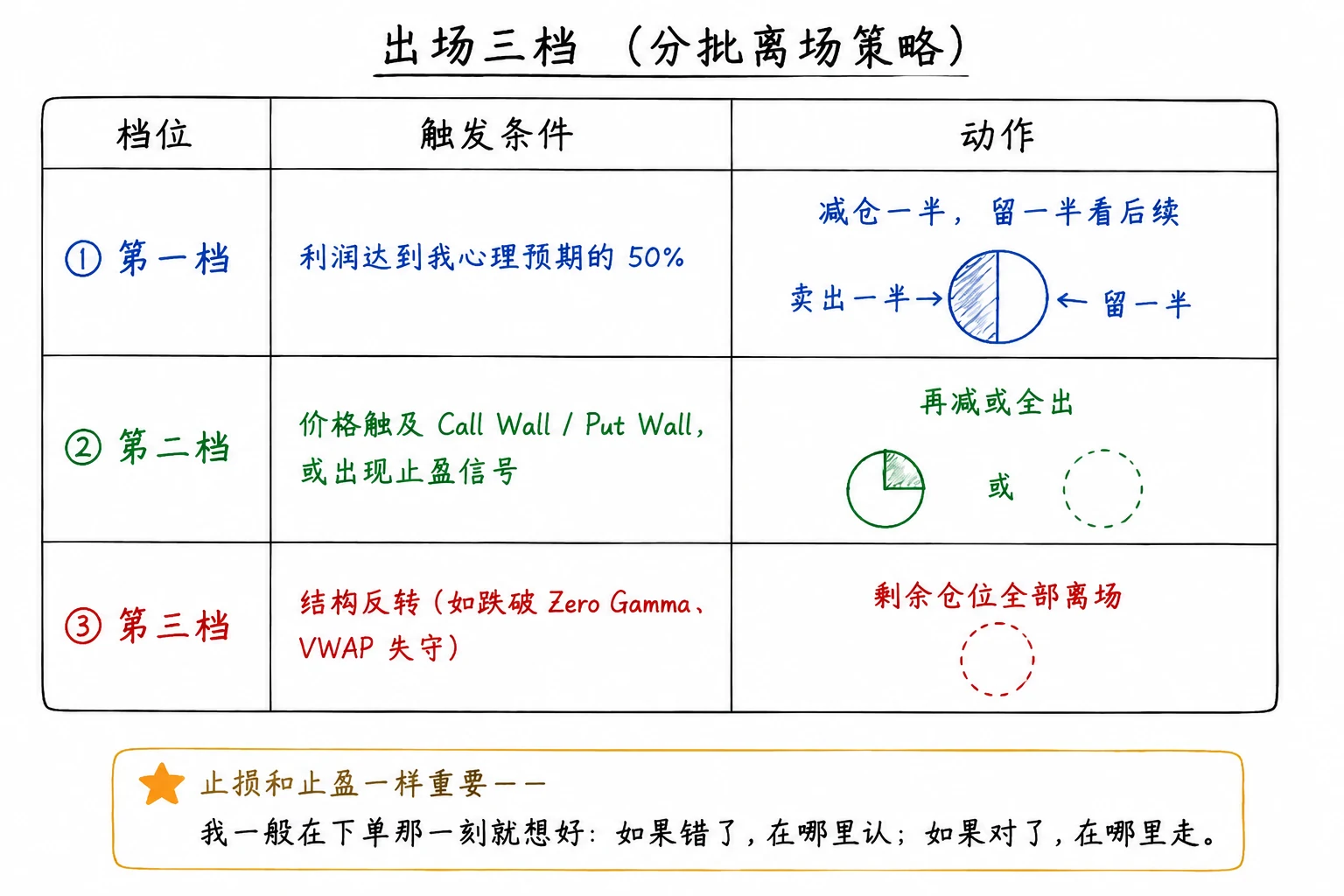
| Stage | Trigger | Action |
|---|---|---|
| First | Profit reaches roughly 50% of the move I expected | Sell half; keep half for continuation |
| Second | Price reaches the Call or Put Wall, or a profit-taking signal appears | Reduce again or exit fully |
| Third | Structure reverses—for example, Gamma Flip breaks or VWAP fails | Exit everything remaining |
The first stage's “expected move” need not be an exact target. It can be directional: “This may reach the Call Wall.” If price travels halfway, reduce part of the position. Do not wait until the target arrives before thinking about the exit. Lock profit along the road.
The first stage secures half. The second reduces at the wall or signal. The third leaves when structure fails. A stop is as important as a target: decide at entry where you admit error and where you leave if right.
Entry requires courage; exit requires discipline. You complete the trade only when you ride the Gamma burst and step off after it ends.
How does this combine with the holding window? One framework watches structure; the other watches time. Whichever triggers first governs the reduction:
- Time first: after 20–30 minutes, profit meets expectations but the wall has not been touched → take the first reduction; the Gamma window waits for no one
- Structure first: profit expands quickly, momentum remains strong, and the wall is still distant → the position may continue until the second stage at the wall
In one sentence: when either the time window or structural level arrives, act on it—partially or fully. Do not wait for the wall after the window has closed.
Where this method most often fails:
- Refusing to leave: +80% returns to +10%, then becomes negative. Waiting after the Gamma burst is the most expensive illusion
- No exit plan: entry is carefully reasoned; exit relies entirely on feeling
- Treating correct direction as permission to hold indefinitely: in 0DTE, being right for too long can let Theta consume the gain
- Buying a Call at the Call Wall: chasing inside a momentum-exhaustion zone is a common route from profit to loss
- Ignoring the first move while waiting for something larger: after the burst comes chop and falling IV
Event Days: CPI, FOMC, and OPEX
SPX 0DTE on an event day is not the same game as an ordinary session.
Walls have not disappeared. But implied volatility, macro shocks, and capital flow can temporarily overwhelm them.
I do not predict CPI or the Federal Reserve. I do three things: control size, wait for structure, and respect IV pricing.
An event day does not test your ability to read the market. It tests whether you can control your hand.
Three Shared Features of Event Days
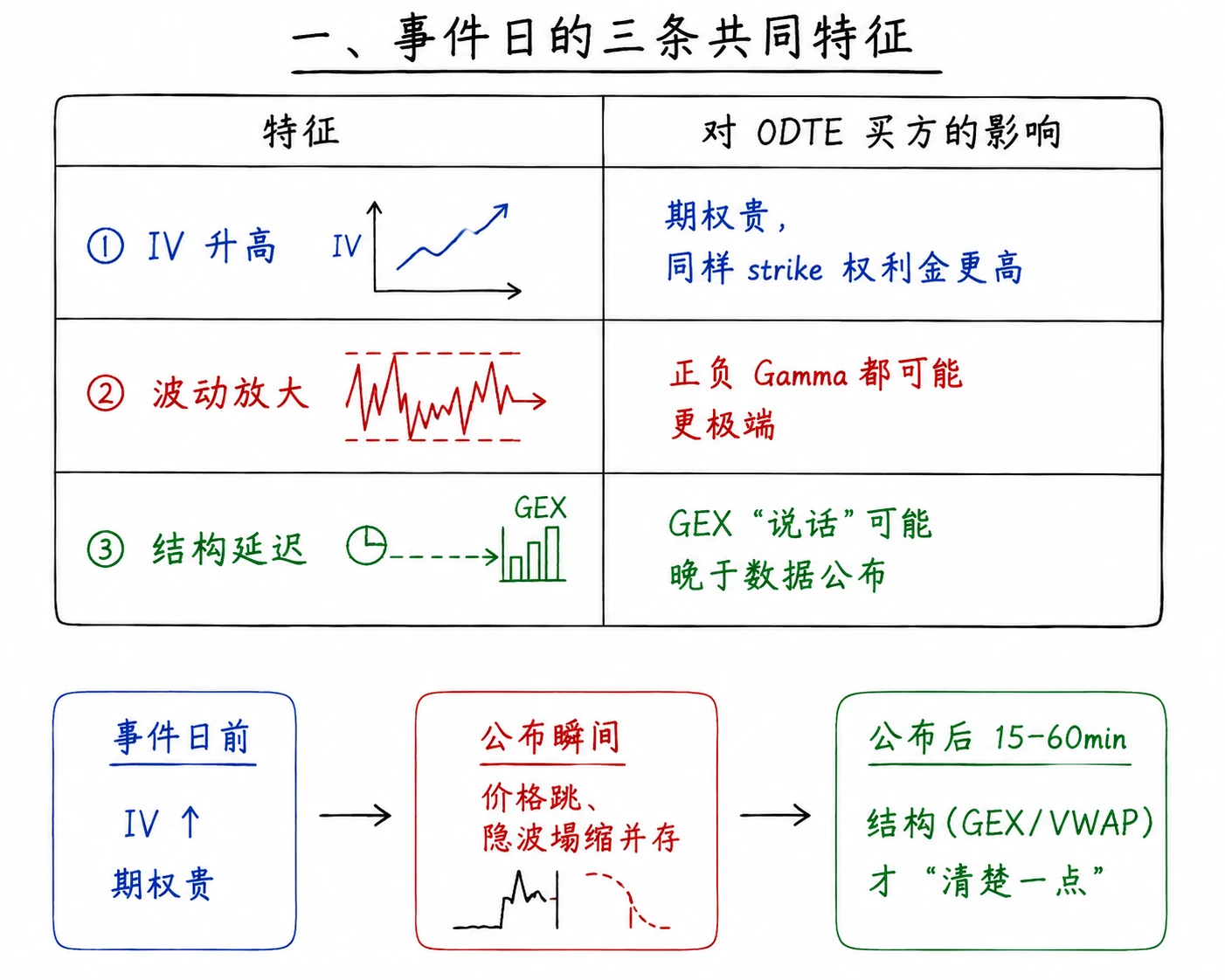
IV rises first. Before a release, the market knows that something consequential is coming. Demand for options rises and sellers ask for more. The same strike costs more than on an ordinary day. The wall has not changed; you must pay more insurance premium for the same directional view. That is a major reason I trade less and smaller.
Volatility expands. Positive- or negative-Gamma behavior can become more extreme. The shock absorber may temporarily disappear; the accelerator may press harder. Gaps and long wicks are normal rather than exceptional. I do not treat quiet as the default or walls as laws.
Structure speaks later. GEX and VWAP are not useless; they are delayed. The macro shock speaks first. I treat the 15–60 minutes after release as a period when structure resets. Whether the Flip, walls, and VWAP realign matters more than guessing the second move immediately.
Event-Day Timeline
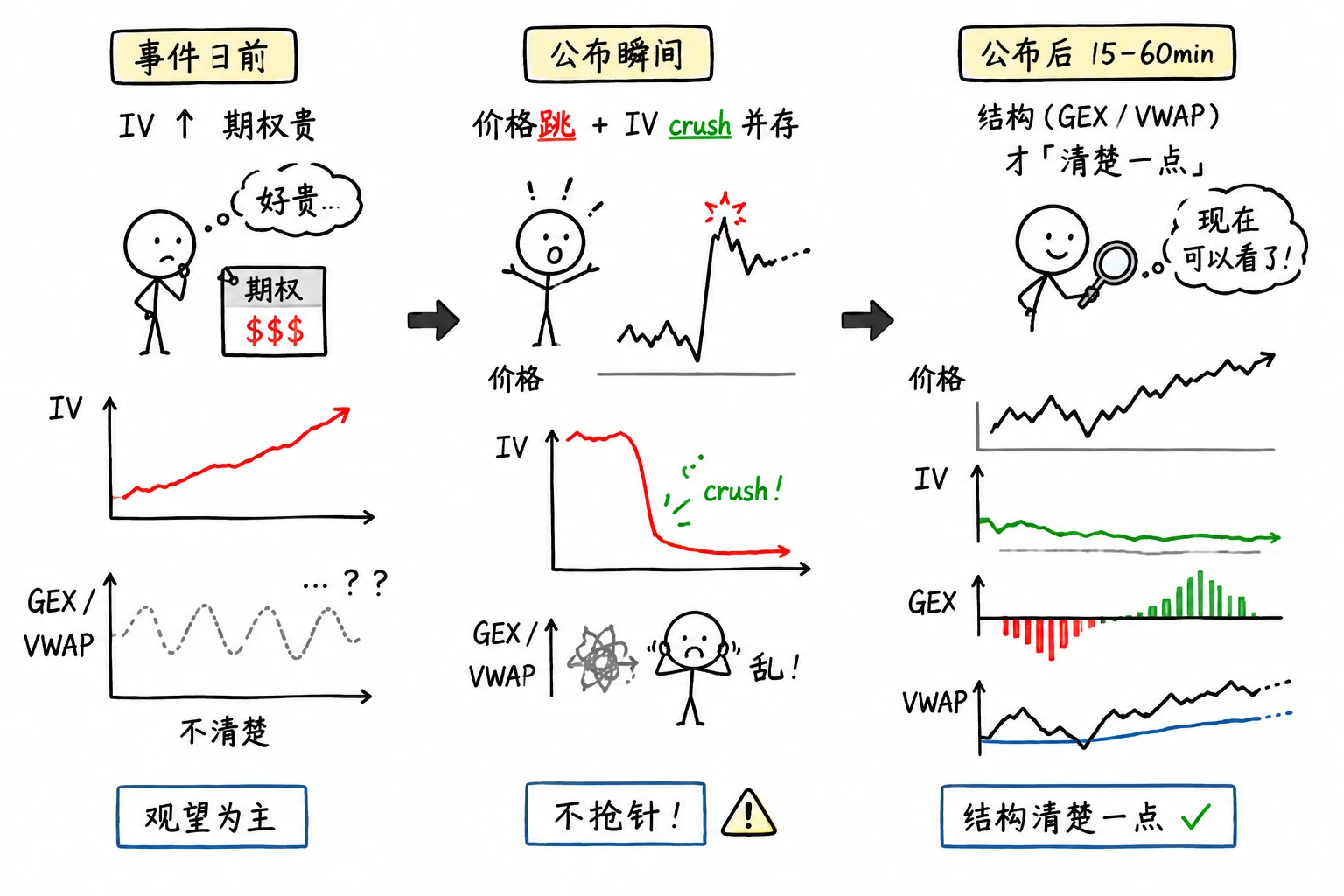
Before the release, IV rises and options become expensive—like airfare before a holiday. Sellers charge more because everyone expects an event. Before you are right or wrong about direction, you have already paid extra insurance. I mark the calendar, mentally cut size, and refuse to fight myself.
At the release, price and IV can jump in different directions. SPX can move your way while your Call shrinks as IV crush arrives. You predicted the number correctly and the account still asks, “What about me?” I do not chase the first wick; it often pierces the wallet rather than revealing direction.
After the release, allow 15–60 minutes for GEX and VWAP to describe the new walls and cost basis. My rule is simple: do less before; read structure afterward. The macro spectacle exits before my ordinary method returns.
CPI, PPI, and Payrolls
Before the release:
- Mark the event time—major US data often arrives at 8:30 Eastern, while Fed events are commonly 14:00/14:30; confirm the current calendar
- Check whether IV is already elevated
- Default to no new position, or only a tiny observation position, before the event
After the release:
- Where did SPX jump relative to the Gamma Flip and Call/Put Walls?
- Is IV falling rapidly? Correct direction can still lose money
- Can price hold VWAP? The cost line is more useful after 15–30 minutes
The classic pain of IV crush: the data agrees with your direction, SPX rises, and your Call barely rises or even falls.
Three forces act at once: direction helps, time hurts, and falling IV may hurt as well.
Correct direction does not guarantee profit when IV collapses. That is not a personal failure; it is an option's structure.
FOMC: Rate-Decision Day
Similar to CPI, but:
- volatility concentrates around the release
- a Powell press conference can create a second move
- IV crush may occur in two stages
My rules:
- A Fed day is the highest calendar risk category
- During the press conference, structure may reverse repeatedly, so the GVP threshold rises
- No revenge entry: do not add after a loss or become careless after a win
OPEX: Options Expiration
OPEX means Options Expiration. It is a general term covering daily, weekly, monthly, and quarterly expirations; it does not inherently mean monthly expiration.
Expiration matters because large open positions settle or disappear, changing market-maker hedges and the character of volatility. Traders focus most on monthly OPEX, the third Friday of each month, because position size is larger and its effect on Gamma, Pin behavior, and walls is more visible. Unless otherwise stated, OPEX below refers to monthly expiration.
Why is monthly OPEX different?
- Monthly options and 0DTE overlap
- More strikes contain exceptionally heavy OI
- Pin + Charm can become stronger near the close
| Practice | Reason |
|---|---|
| Reduce size during OPEX week | See Position Size below |
| Rarely open new long-premium 0DTE after 15:30 | See Charm in Chapter 3 |
| Do not bet the Pin direction | A Pin is a phenomenon, not a prophecy |
| If trading, rely on full-session GEX, not a guessed round-number close | See Pin in Chapter 3 |
The February 13 and February 17 cases did not depend on the Pin. Wall logic can remain useful during OPEX, but the clock becomes more dangerous.
Month-End, Quarter-End, and Rebalancing
Institutional rebalancing and window dressing can create:
- mechanical flow unrelated to GEX
- abnormal Volume near the close
I treat them as days when structure may be distorted. Raise the GVP threshold and stop after consecutive losses.
Common Event-Day Failures
- A large directional bet before the event—expensive IV plus a binary outcome
- Holding through IV crush after the release—correct direction still loses
- Ignoring GEX and reading only news—or forcing wall logic while macro flow overwhelms it
- Revenge entry—trying immediately to recover a loss
- Betting on a Pin at the OPEX close—a tendency is not a guarantee
- Treating one correct guess as repeatable skill
Correcting Event-Day Misreadings
| ❌ | ✅ |
|---|---|
| Predict whether CPI will be good or bad | Predict whether you can control size |
| Chase the first move with a market order | Wait for structure |
| Add leverage on an event day | Lower expectations |
| Assume walls must work immediately | Walls may speak later |
| Believe every event must be traded | Choose not to trade |
On event days, I do not guess the number. I control size, wait for structure, and respect IV. Macro forces can temporarily override walls, but risk remains in my hands.
Event-Day Checklist
See the Appendix Event-Day Checklist for the full version:
- Is there a high-impact macro event today?
- Is IV visibly higher than in recent sessions?
- Do I already have a plan to avoid or reduce pre-event positions?
- Will I wait 15–30 minutes after the release before reassessing GEX and VWAP?
- Have I lowered today's position-size ceiling?
Checking every box does not guarantee profit. It reduces impulsive trading.
What Position Size Stops Being a Bet?
I wrote this section slowly.
Not because it is difficult, but because I paid real money for every rule.
I have used excessive size. GEX and structure looked right, so I thought, “This one is safe,” and pushed everything in. Direction was correct, but an ordinary pullback forced me out. The market was not wrong. My position was too large to tolerate normal volatility.
I wrote one sentence afterward: “Right” and “large” are different. Being right describes direction. Being large means refusing to leave room for error. Error is inevitable; leaving no room for it is the larger mistake.
The appendix explains three facts about long options: low hit rate, high payoff, and toxic time decay.
In that structure, position size is not an optimization problem about profit. It is a survival problem: will you remain for the next trade?
In June 4 and March 26 reviews, the deepest losses often came not from misunderstanding GEX but from the combination of size + adding + no stop.
The first rule of 0DTE is survival. The second is remembering the first.
The Mathematics of a Long 0DTE Position
For a Long Call or Put, the maximum loss is the premium paid.
Approximate trade risk = Premium × Number of contracts × $100 SPX multiplier
Example, arithmetic only:
- Premium $8, two contracts → maximum loss ≈ $8 × 2 × 100 = $1,600
- On a $50,000 account → approximately 3.2% in one trade
Only you can decide whether that percentage is acceptable. I do not prescribe 1% or 2%. I provide the calculation and one question:
If the entire premium disappears, will you sleep tonight?
If not, the position is too large. GEX is irrelevant.
Position Rules
Rule 1: cap the maximum loss per trade. I limit full-premium loss to a small portion of capital. The exact percentage changes by person and stage. What matters is calculating it before the order.
Rule 2: do not average down.
Add to a mistake → reinforce the wrong direction → average down without limit
Every addition to a wrong direction deepens the hole. That is an attempt to recover, not trading.
The earlier me: loss → add → lose more → hold to expiration.
The current me: structural invalidation → leave → the assignment ends.
Adding does not repair the cost basis. It extends the duration of the loss.
Rule 3: cap simultaneous positions. I avoid turning five long 0DTE contracts into a disguised portfolio gamble:
- correlated directions create hidden doubled leverage
- when one loses, they often lose together
Set the limit for your account. The principle is that you can calculate total risk.
Rule 4: become more conservative on event days. CPI, FOMC, and OPEX do not require a mechanical 50% reduction, but they do raise the threshold for entry and accelerate exits from existing positions.
Rule 5: reduce size or stop after consecutive losses. After three losses, do not double down to recover. Halve size or stop for the day.
After consecutive losses, the worst possible goal is winning everything back in one trade.
Position Size vs Structure: Which Comes First?
Traders ask: if I read GEX correctly, why did I still lose? Figure 7-6 shows three pillars—structure, position size, and stop. Each has one job; remove one and the trade cannot stand.
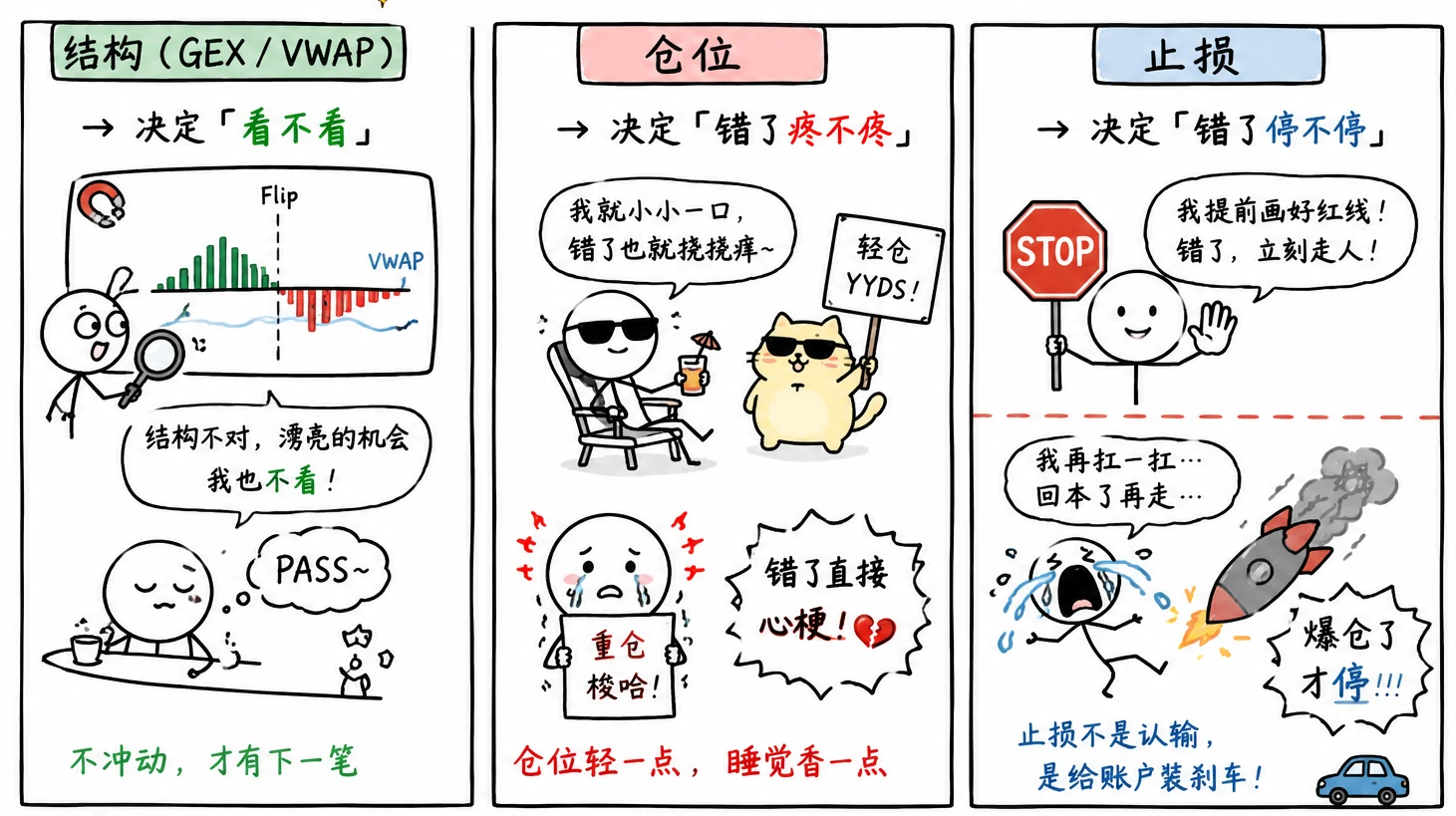
Structure—GEX and VWAP—decides whether the day is worth attention. GVP alignment raises priority. Conflict helps me trade less; it does not urge me to find an order.
Position size decides how much an error hurts. A long 0DTE can lose only its premium, but the multiplier is 100. Enough contracts turn a small displayed number into a sleepless night. Good structure cannot rescue an account from repeated excessive size.
The stop decides whether the error ends. A stop is not cowardice. It is the abandonment point written when the order is placed. Structure may permit further observation; the stop says this particular trade is finished.
Together: structure filters, size limits pain, and the stop cuts the power. On June 4, the data filled the page with an answer. Shorting against it, holding, and refusing to stop remained a fatal combination.
Six Red Lines to Write Before Ordering
- “The option is cheap, so I can buy more.” Wrong. With the $100 multiplier and possible full loss, a small quote can still cause serious damage.
- “I can double after consecutive losses and recover.” Wrong. Reduce size or stop; surviving the curve matters more than urgent recovery.
- “One 0DTE contract is only a small bet.” Wrong. The full premium can disappear.
- “A stop shows weakness.” Wrong. It defines tuition and the abandonment point at entry.
- “I can copy someone else's size.” Wrong. Size belongs to the account and psychology of the individual.
- “Excellent structure permits a large bet.” Wrong. Good structure plus excessive size and no stop can still remove you from the game.
A Ten-Second Check Before the Order
See the Appendix Position-Size Self-Check:
- What is the dollar loss if the premium goes to zero? What percentage of the account is it?
- Where is the stop or abandonment point?
- Is today an event day? If yes, become more conservative
- Am I calm, or am I trying to recover a loss?
A wrong answer to the fourth question usually means no order.
In 0DTE, size is not about how much you can earn. It is about whether a mistake leaves you able to play the next hand. The market always offers another opportunity—if you remain alive.
Position Size by Account Stage
I do not prescribe “always 2%,” but I distinguish stages:
| Stage | Tendency |
|---|---|
| Learning | Smaller, slower, and fewer repetitions |
| Stable | Set a personal ceiling and enforce it |
| Losing streak | Reduce, never increase |
| After a large gain | Do not double for 72 hours; see below |
When the stage changes, the sizing rule should change. Freezing one number forever can become another form of gambling.
After a Large Win or Loss
Event-day and sizing rules govern one trade. This section governs the period after a large win or loss. Emotion carries the last result forward even though the next trade remains a new statistical sample. My windows are 24 hours after a large loss and 72 hours after a large gain.
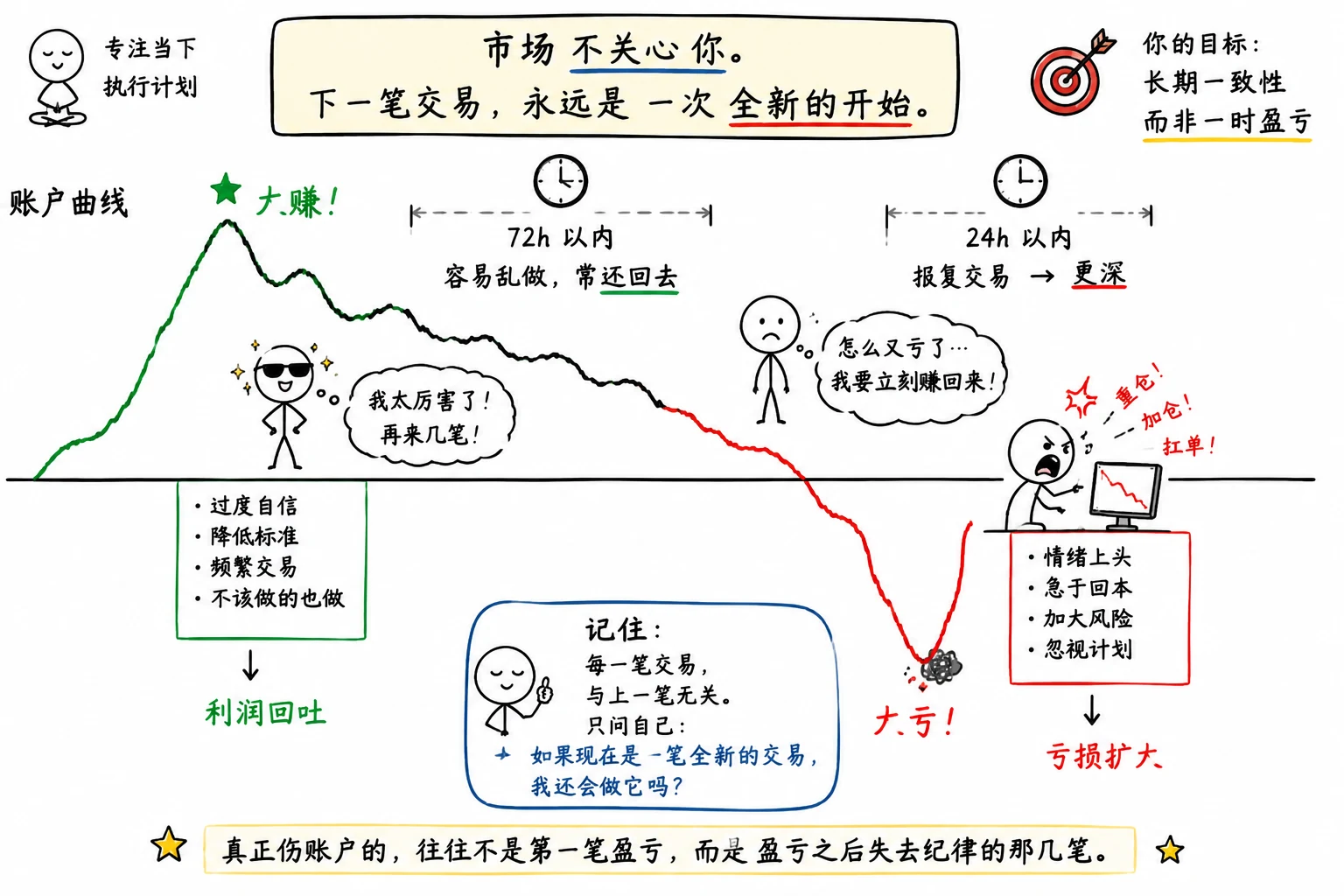
Both large wins and large losses can pull a trader away from the plan.
Many assume loss creates the greatest risk. A large gain can be equally dangerous. It took me time to believe that.
After a strong profit, the brain quietly concludes that it has finally “understood the market.” Standards loosen and bad trades become attractive. The market has not changed; perception of risk has.
I experienced it. After four profitable days, I looked at Friday's market and thought, “At my current level, this trade cannot be wrong.” I refused a stop, kept full size, and held. One trade returned the week's entire profit and more.
I sat before the screen after the close, angry not at the market but at myself. I knew every violated rule. The distance between knowing and doing was the belief that I could not be wrong.
That experience produced my 72-hour rule after a large win. I am not afraid of the market; I am wary of the version of myself that believes he has arrived.
A large loss produces the opposite trap. The loss itself may not destroy the account. The impulse to earn it back immediately often does. Attention shifts from whether the opportunity fits the rules to how far the account remains from breakeven. Trading stops being execution of an edge and becomes emotional self-repair.
The market neither rewards a recent winner nor pities a recent loser. The next trade has no emotional relationship to the last. Ask only:
If this were an entirely new trade and I did not know the result of the previous one, would I still take it?
When the answer is no, waiting is often best. My two windows are not vacations but mental resets. I can read GEX and write reviews, but I do not transact. No doubling, averaging, reverse all-in, or “only this once” exception.
The first 24 hours after a large loss: leave the screen for two hours after closing. From hour 2 through 24, open no new position—or observe only on paper. Write the review: Which structural premise failed? Did I execute the stop? Was size excessive or did I add? Was I trading probability or filling a hole? If the mind remains disordered, extend another 24 hours. Do not answer, “The market hurt me.” The market owes nothing.
The first 72 hours after a large gain: during the first day, normal trading is allowed but never above the ordinary size ceiling. From hour 24 through 72, no doubling and no “celebration trade.” Review whether the win came from structure or luck. Only after 72 hours do I allow the mind to return to its ordinary state. The hardest task after winning is not keeping the money. It is keeping the clarity that I can still be wrong.
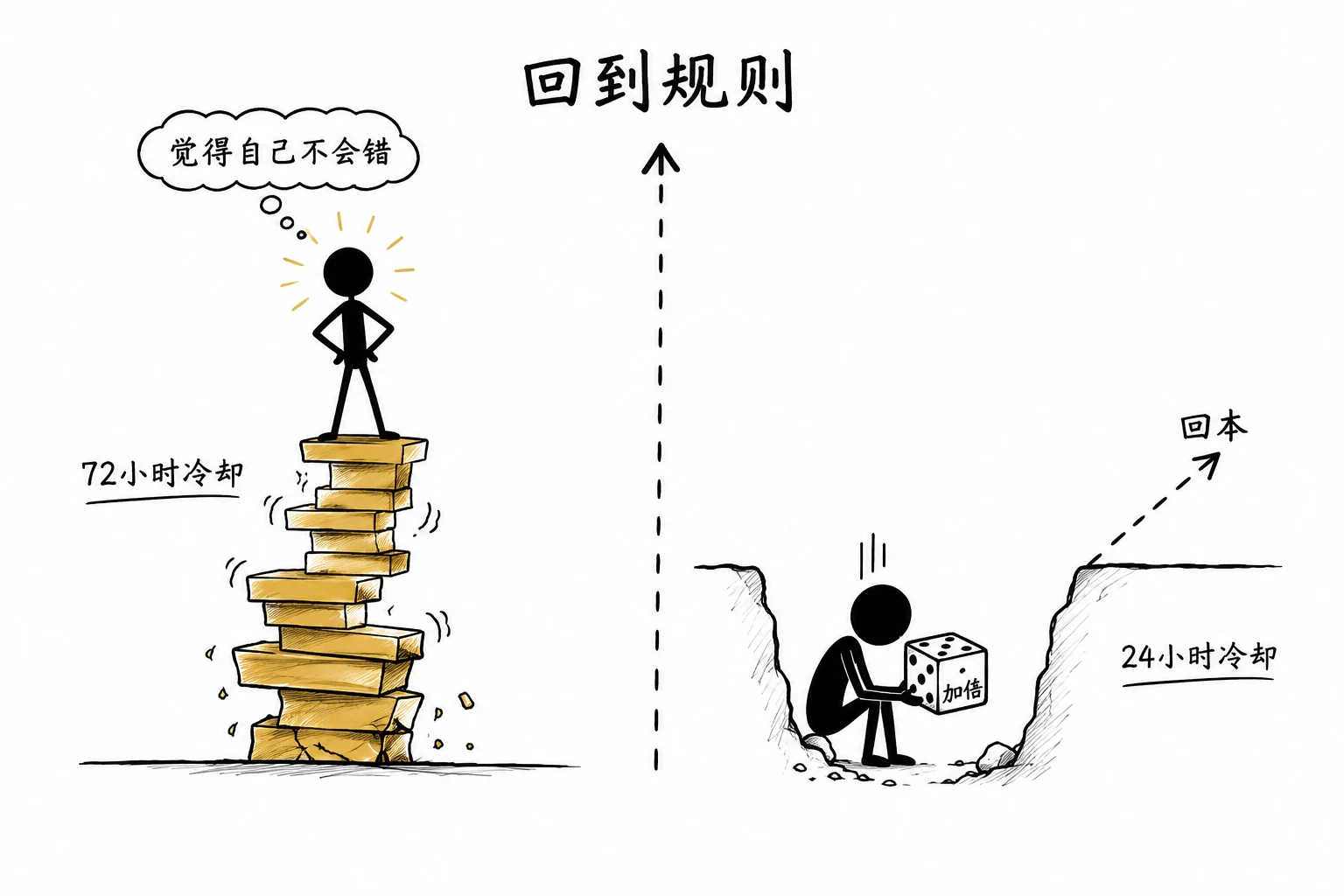
Books on trading psychology return to one plain idea: each trade is a tiny part of a probability distribution, but the human brain turns it into a statement about identity. Being “in the zone” means that whether this trade wins or loses does not change the fact that I will be both right and wrong again. A cooling-off period pulls me from the need to prove myself back into process: Is structure still present? Was size calculated? Is the stop written?
June 4 taught respect for data, trend, and stops. March 26 showed the danger of averaging after structural failure. A large gain produces oversizing and the possibility of returning everything at once. The technical lessons differ; the psychological hole is often the same. Trading immediately after a win or loss, turning review into blame, treating cooling-off as weakness, and making “one exception” are all expensive. Twenty-four hours to survive a loss, 72 hours to remain stable after a win, four review questions, and cooling-off to preserve decision quality are not weakness. They acknowledge that the next trade is a new sample.
I mark large-loss days red and large-win days yellow on the calendar. My review template begins with six Chinese characters that translate simply as: survive the loss; stabilize the win.
After a loss, you want recovery. After a win, you believe you cannot lose. Neither state trades well.
A clear mind matters more than another order. Survival matters more than one win.
While writing this chapter, I repeatedly asked: if I read GEX and direction correctly but still lose, do I know how to trade?
The answer I accepted was: halfway. The other half is not on the chart. Can I leave while profit still exists? Can I accept that an event day does not deserve a large bet? After consecutive losses, can I remove the self from the market rather than finding another trade to prove something?
The market never promises that because the last trade was right, the next will be right. 0DTE magnifies that truth by the minute. When the Gamma window closes, it is closed. When IV collapses, it has collapsed. If the cooling-off period is unfinished, it is unfinished. Every trade is a new probability sample. The only thing I control is whether I arrive at the next bet clean.
Clean does not mean emotionless. It means knowing what I am doing: trading probability rather than seeking justice; managing exposure rather than proving intelligence. The dividing line between gambler and trader often appears in the minutes after a large gain or loss—does the hand still obey?
June 4 says: do not fight the trend; respect the data; leave when the stop is reached. March 26 says walls can collapse. A large win says: remain humble for 72 hours. These are not merely techniques to copy. They are the slow process of removing the hand from its default setting. Imperfection is acceptable. The market will be here tomorrow. If you are still here, you have another opportunity to follow the rules. Longevity comes not from one enormous win, but from keeping both the account and the person standing on most days.
January 23 waits in the next chapter—a day of narrow range and lukewarm price action, yet dense structure beneath the surface.