Chapter 1 · Gamma Was So Strong—Why Did Anyone Still Go Short?
Opening verseTo the Tune of Lin Jiang Xian · With the Trend
Every voice says the rally has gone too far,
yet I watch the walls rise tier by tier.
One wall breaks; another forms above.
At lofty prices, others turn against the move;
I travel with the wind.
Why argue with the market over a single belief?
Let sun and shadow pass across the tape.
The tide declares itself as it comes and goes.
The walls rise; my mind stays still.
With the current, one boat travels light.
Let me begin with June 4, 2026.
It was an ordinary one-way rally. Yet days that look as though they “must be due for a pullback” are precisely the days that most easily lure traders into shorts. I did not place a large trade that day, and I captured only a small swing. But the session made one point unmistakable: all day, price shouted, “This has risen too far,” while the options walls kept saying, “Do not short.”
If you have not read the GEX map guide, you can turn first to “Understand Options Walls in Half an Hour.” You do not have to. This chapter still makes sense on its own: who read that day correctly, and who did not?
The First Half Hour: I Expected a Range
Nothing unusual happened in the first 15 minutes. The data looked stable. At 9:45, I glanced at the options walls:
- Call Wall 7550—the ceiling overhead
- Put Wall 7530—the floor below
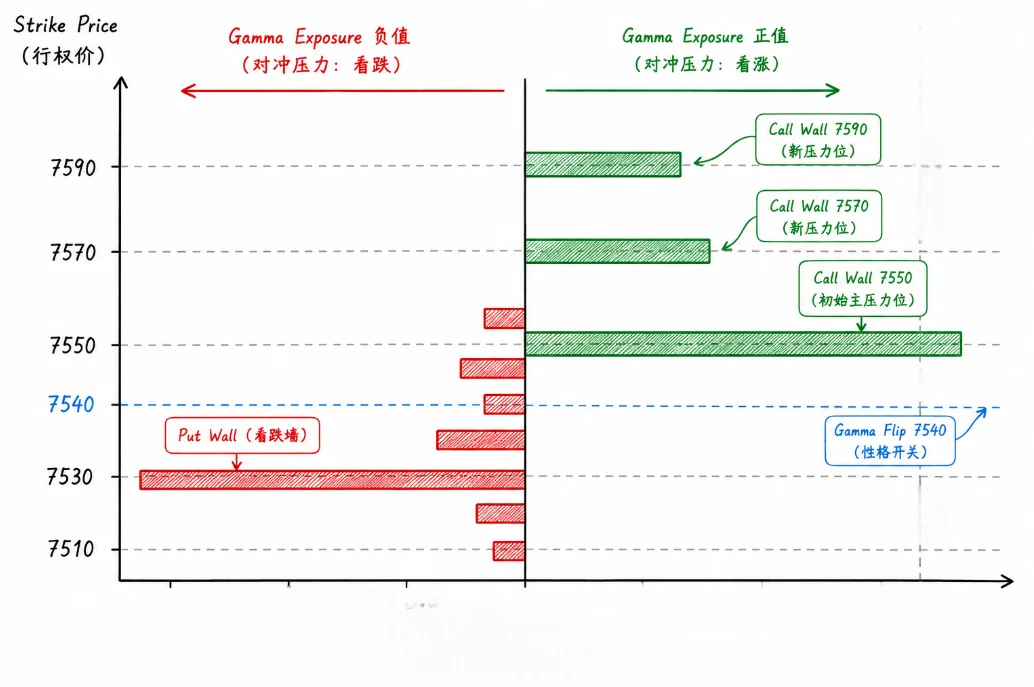
Figure 1-1 shows the structure I saw: a Call Wall capping the market at 7550, a Put Wall supporting it at 7530, and price resting against the lower floor. I thought there was support, so I tried a Call. Price bounced briefly; I exited near 7545 and captured a small swing. At that point, I was still thinking in terms of a range: buy at the Put Wall and sell at the Call Wall.
Price followed that script at first. It touched the 7550 Call Wall, met resistance, and pulled back. The session looked like a 7530–7550 box.
What happened next tore up that script.
The Walls Began to Move Higher
Price did not stop at 7550. It surged through on volume.
I watched the options-wall map change. The old Call Wall was consumed, and new walls appeared at progressively higher levels:
- 10:23—the Call Wall moved to around 7570
- 11:10—it shifted again to 7575
- 13:15—it rose to 7590, while even the Put Wall climbed to 7550
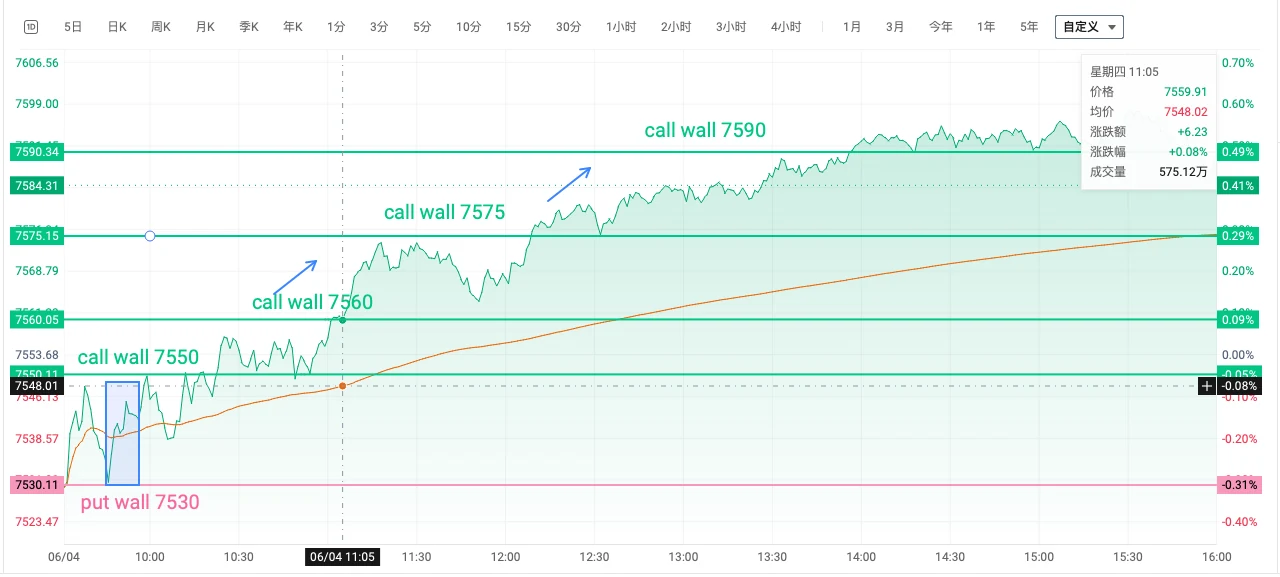
Figure 1-2 traces the entire session. At the open, the Put Wall was 7530 and the Call Wall was 7550. Price found support near the Put Wall and began to rise. After 7550 broke, new Call Walls appeared one after another—7560, 7575, then 7590 in the afternoon. Price remained above VWAP throughout.
This was not an ordinary rally. The market did not stop at the old resistance. Each time it broke through one wall, it built another at a higher level. Even the floor—the Put Wall—rose beneath it. In options-wall terms, the message was simple but important: structurally, the market was probing higher price ranges and gaining acceptance there step by step.
The important information was not how many points price had gained. It was that the entire structure kept moving upward.
Price can mislead; structure rarely does. That day, price kept shouting, “Too high.” From beginning to end, the options walls said only one thing: do not short.
When I reviewed the data after the close, “strong Gamma” was not an impression. It was visible in the numbers.
Net GEX rose steadily from roughly 10B at the open:
- 11:06—crossed 100B
- 13:28—moved above 500B
- 15:39—reached roughly 1200B
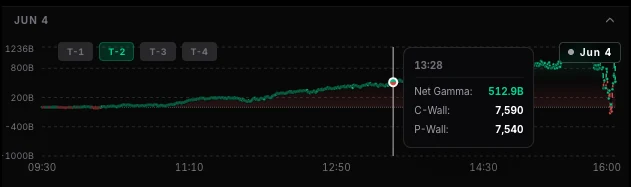
This did not mean “Gamma was bullish.” GEX never tells you whether price will rise or fall. It meant that market makers' positive-Gamma exposure was expanding and the market was operating in an exceptionally strong shock-absorber regime. As price rose, market makers had to sell futures to hedge. Yet that selling never overcame the demand, so price kept advancing and the Call Wall moved higher with it.
In other words, “strong Gamma” did not mean that the market was shouting “up.” It meant: “The structure beneath this trend is stable. Do not fight it.”
Data does not lie. People simply choose which part of it they are willing to believe.
Why I Stayed Bullish While Others Wanted to Short
Halfway through the rally, some traders could no longer resist.
Some went short around 7550 or 7570, betting on a pullback, only to be run over as the market continued higher. Others waited for an even higher price before acting, thinking, “Surely this must be the top.” But the structure was still climbing.
Here is the most counterintuitive fact about a one-way rally: only one short entry is right—the one at the exact high. Every other attempt to pick the top is wrong. No one knows in advance which attempt will coincide with that high.
The same market can produce opposite conclusions through two different sets of eyes.
The ordinary trader sees an overextended rally and an overbought RSI, then wants to short.
The options-wall trader sees something else: price above the Gamma Flip, price above VWAP, the Put Wall moving farther below spot, one Call Wall after another breaking, and open space overhead.
I do not pick tops; I follow the move. Not because I am smarter than anyone else, but because I learned to ask about structure before asking about price. When every structural step says, “This is not over,” I have no reason to stand on the other side.
What did the data actually say that day? Here are the scattered clues in one place:
- The Call Wall advanced from 7550 → 7570 → 7575 → 7590
- The Put Wall rose from 7530 to 7550; the floor moved higher too
- Price stayed above VWAP throughout the session
- It spent only brief moments below the Gamma Flip and most of the day above it
In one sentence: the signal was not, “It feels due for a pullback.” It was that at every step, the structure said, “This is not over yet.”
What I Want You to Remember from This Chapter
After the close, I did not write down how much I had made. I wrote these lines:
A market that has risen too far is never, by itself, a reason to short. A structural turn is.
When others call a top by feel, I ask the structure one question: Are the walls still being built higher?
The most expensive thought in a rally is, “It cannot go any higher.” The market has a particular taste for punishing that sentence.
The market rarely punishes you merely for being wrong. What it truly punishes is being right but unable to hold—and being wrong but unwilling to admit it.
This chapter was about reading structure: why one trader sees “do not short” while another sees only “too high.”
In the next chapter, we return to the structure itself. Who are market makers? Where do options walls and GEX come from? Why does price gravitate toward a wall, and why can one wall after another form at progressively higher levels? You will begin to see that the message from that day—“do not short”—was not a feeling. It was the structure speaking.