Chapter 9 · Think Like a Market Maker: From Guessing Direction to Reading Structure
Opening verseTo the Tune of Ding Feng Bo · Composure
Do not ask how fierce tomorrow's wind will be.
Why not hold the page before your reflection and remain at ease?
Let wild tides rise in all their noise—
who is afraid?
With a rain cape and a settled heart, walk east or west.
Look back at the layered clouds along the road.
Who says half a lifetime of rise and fall was empty?
Without regret and without frenzy, return;
a mind like still water carries no burden.
The first eight chapters read the market: GEX, walls, VWAP, GVP, and repeated trade reviews.
For a moment, set the technique aside.
Change perspective.
Try to think like a market maker. Do not rush to decide up or down. Ask first: Where is the risk? Who is compelled to act? Where might the next hedge push price?
In a market maker's world, there is no directional allegiance—only risk management.
A Market Maker Does Not Think “Up or Down”
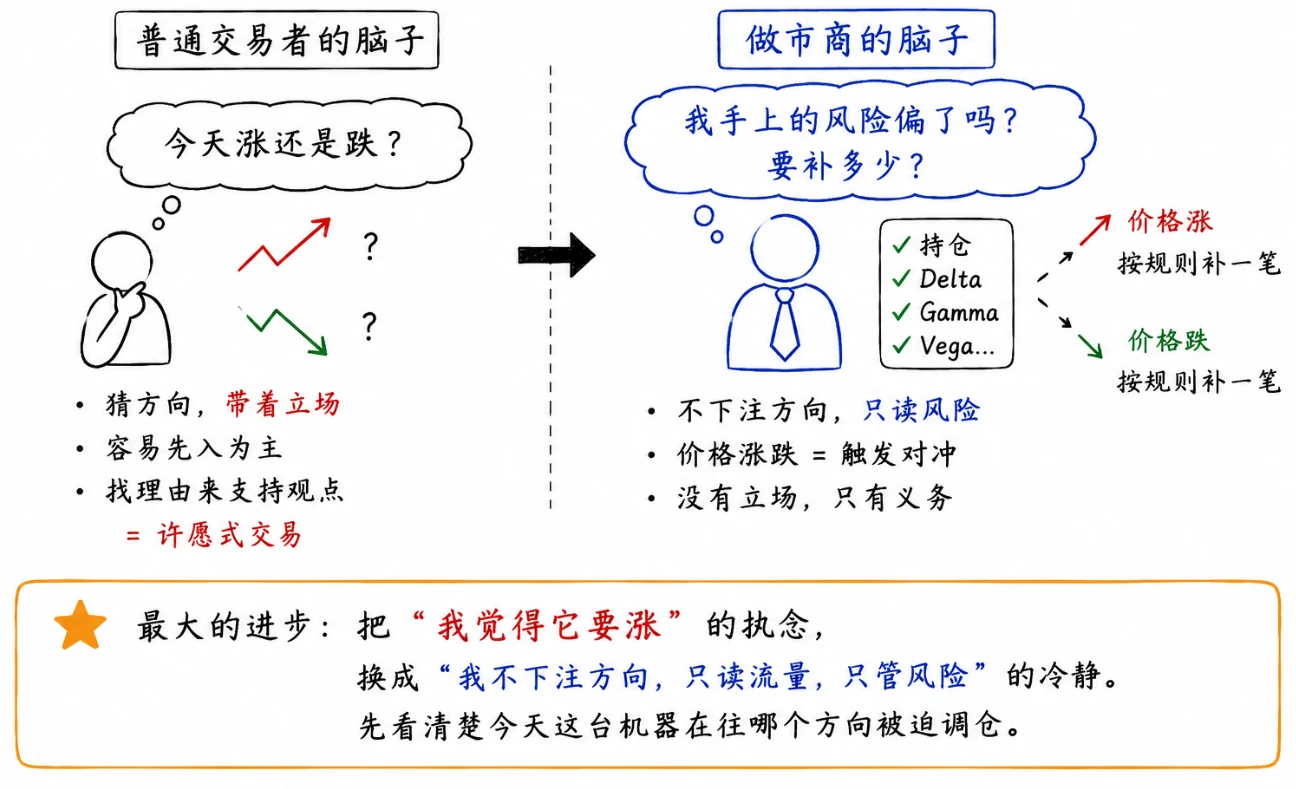
I used to wake and ask, “Will the market rise or fall today?”
A market maker asks something else: “Has the risk on my book become unbalanced, and how much must I hedge?”
It does not care whether you are bullish or bearish and does not cheer for either side. If price rises, it adjusts according to a rule; if price falls, it adjusts in the other direction. No allegiance—only obligation.
I thought about that for a long time. A major step for an ordinary trader may be replacing the fixation “I think it will rise” with the market maker's calm: “I do not need to bet first. I read flow and manage risk.”
You may still have a directional view. But restrain the impulse long enough to see which way the machine is being compelled to rebalance.
This is only one way I think. It may not fit you. For me, it has been more useful than any indicator.
Character first; direction second. The ordinary sequence is: ask up or down, then search for reasons.
The market-maker sequence reverses it: identify whether the day damps or accelerates movement, then decide whether action is justified.
Before every open, I force myself through the second sequence—the three premarket tasks in Chapter 5:
- Is today more like a shock absorber under positive Gamma or an accelerator under negative Gamma?
- Where are the walls and the VWAP cost line?
- Do GEX, VWAP, and price action align?
Only afterward may I ask whether I want to be long or short. Reverse the order and you fall in love with a direction, then mine the chart for supporting evidence. That is not market reading. It is wishing.
Turn Actions into a Program
Market-maker hedging is consistent because a computer program executes it without emotion. When the condition appears, the order occurs—without hesitation, revenge, or hope.
A trader cannot become perfectly mechanical. But the actions most vulnerable to emotion can be written into rules:
- Stop location—set when the order is placed; do not move it impulsively
- Maximum loss per trade—calculate before the open; do not increase it intraday
- Event day or losing streak—reduce risk automatically; see Chapter 7
When these become a “program,” the calm premarket version of you governs the vulnerable parts. The impulsive intraday version does not deserve those decisions.
Audit yourself: am I trading probability or filling a hole? A market maker reconciles its risk exposure at the end of the day.
My reconciliation is four review questions:
- Structure: which part of GEX, VWAP, or GVP did I misread?
- Execution: did I take the stop when required?
- Position size: was it too large, or did I keep adding?
- Identity: was I trading probability, or trying to recover and repair myself?
The fourth is the hardest. Once the answer is “filling a hole,” the act is no longer trading. It is anger. A market maker does not take the market personally; it has no pride requiring validation. I am still learning that.
A stop is a promise, not a punishment. Many traders experience a stop as admitting defeat and cannot execute it.
Think differently. The stop is a promise to yourself. The calm person before the open tells the impulsive person during the session: “If this line breaks, leave, because the version of you in that moment cannot be trusted.”
When a market maker closes an uncontrolled exposure, it feels no shame. It simply returns risk to balance. A stop does not mean the market defeated you. It means you defeated the part of yourself that wanted to hold without limit.
There is no universal stop width. The psychology is the point: promise, not punishment.
It took me a long time to remove “stop = admitting error” from my mind. Now, after a stop, I tell myself: “Assignment complete. Next trade.”
An Edge Appears Through Repetition
A market maker does not survive on one enormous win. It repeats a small edge thousands of times and does not attach identity to one outcome.
That is difficult for a long-premium trader to internalize. One trade contains a large element of luck; a long series reveals whether an edge exists.
I try not to become emotional over one result. Winning does not prove that I was right; losing does not prove that I was wrong. Whether I followed the rules is the part I control. Probability and repetition own the result.
That is why this book contains neither signals nor income screenshots. A way of thinking can be repeated; one trade on one day cannot.
Exercise: trade an edge like a casino. A casino does not win every hand. It repeatedly accepts bets only under rules that provide an edge and never becomes impulsive over one outcome.
Try this exercise with real or simulated trades; no dollar amount is required:
Record 20 consecutive trades. Before every order, write four statements:
- What is today's character—damping or acceleration?
- Is GVP aligned—GEX, VWAP, and price action?
- What is the full-premium loss, and can I accept it?
- Am I calm or trying to recover?
After 20 trades, do not begin with profit. Count how many were entered only after all four statements had answers.
The exercise is not about win rate. It trains you to act only when your rules are complete and to become emotionally neutral toward one outcome.
A gambler rushes to prove that he is right. A trader quietly places the bet only when probability leans to his side.
This is my practice. Adapt it to your own.
A friend once asked: “After everything you have studied and written, what remains?”
I thought for a long time. What remains is: “I know I can be wrong, and I still dare to place the trade.”
Not from confidence. I priced error into the position before entry: small size, a clear stop, and structure speaking on my behalf. If wrong, accept it and adjust. There is nothing to prove.
That may be the greatest change brought by thinking like a market maker: I no longer need the market to prove that I am right.
This book has traveled through market makers, GEX, walls, VWAP, GVP, exits, sizing, and seven trading days. Its final message is simple:
Do not rush to guess where the market will go. Learn from the calm hedging machine: read today's wind, control your risk, and give your actions to rules.
You will not guess direction correctly every day. But thinking like a market maker can help you survive wrong days with greater clarity.
Survival and clarity are the foundation of everything else.
These are my interpretations and practices in SPX 0DTE trading. They may be wrong.
Markets change, and I continue to revise my thinking. Use or question this framework as you choose,
but make your own decisions and accept your own risk.